
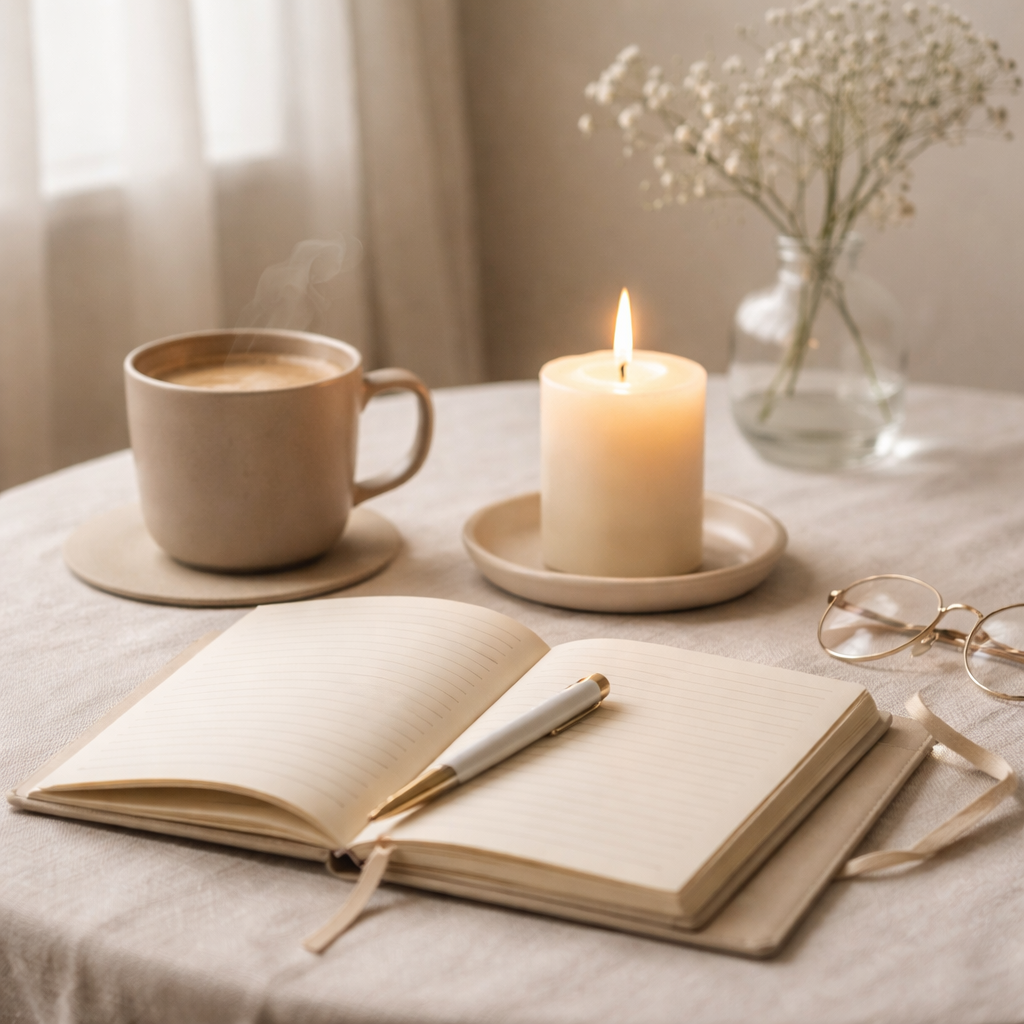
I’ve been accused of romanticizing my life the way people accuse you of leaving fingerprints on glass. As if beauty is evidence of guilt. As if lighting a candle means I’m staging a scene instead of living inside it.
But romanticizing isn’t the problem. Not really.
Avoiding is.
Romanticizing, at its best, is attention. It’s the practice of looking at what’s already here and deciding it deserves to be witnessed. It’s choosing a nicer plate because you are, in fact, here for dinner. It’s turning the shower into something sacred not because you’re running away, but because you’re coming back to your body.
Romanticizing is not the lie. It’s the frame.
Escapism is the lie. It’s the frame you build so you don’t have to look at the picture.
There’s a difference between making a life beautiful and making it unrecognizable.
I know because I’ve done both.
There was a version of me that curated softness like a barricade. I mistook “aesthetic” for “safe.” I thought if I could make my days look gentle, they would feel gentle. I kept my spaces pristine because mess felt too much like proof that I couldn’t handle things. I bought fresh flowers like I could buy freshness. I posted the sunset, not the aftermath.
That’s not romanticizing. That’s negotiating with reality.
Avoidance dresses up well. It borrows the language of wellness and the wardrobe of calm. It can look like clean countertops and a perfectly timed morning routine. It can look like a Pinterest board that becomes a substitute for a decision. It can look like “I’m protecting my peace” when what you mean is “I don’t want to have that conversation.” It can look like minimalism that’s less about clarity and more about control.
It’s easy to confuse the two because both can be beautiful. Both can be quiet. Both can be intentional.
But one makes you more present.
The other makes you disappear.
I used to think escapism was something obvious. A dramatic exit. A hard turn away. A plane ticket bought on impulse, a romance that starts like fire, a weekend that turns into a month. And yes, escapism can be loud. It can be glittering.
But the kind that lives in me is often very subtle.
It’s staying busy with the small rituals so I don’t have to touch the big feeling. It’s polishing the surface of my days until they shine, hoping no one notices the crack. It’s consuming beauty so I don’t have to create change. It’s turning my life into a moodboard when what I need is a map.
Sometimes I romanticize because I love being alive. Sometimes I romanticize because I can’t stand being alive the way it currently is.
The difference is always in the body.
Romanticizing feels like breath returning.
Avoidance feels like holding it.
Romanticizing is when I make coffee and actually taste it. When I put on a good outfit and feel more like myself, not less like my problems. When I walk slowly and notice the world has been waiting for me to look at it. When I light a candle and it doesn’t mean “pretend,” it means “arrive.”
Avoidance is when the candle is lit and I’m still not in the room.
It’s when the playlist is perfect and my mind is elsewhere, rehearsing a conversation I won’t have. It’s when I buy another notebook instead of writing the hard paragraph. It’s when I rearrange my furniture because I can’t rearrange my life.
This isn’t a condemnation of softness. I love softness. My whole aesthetic is built around it: clean lines, quiet mornings, the kind of beauty that doesn’t demand applause.
But softness without honesty becomes a sedative.
And I don’t want to be asleep in my own life.
There’s a particular kind of escapism that gets praised online. It’s packaged as self-care and sold as a lifestyle. It’s the idea that if you keep your world pretty enough, nothing can touch you. That if you choose the right palette, you’ll stop feeling the wrong emotions.
But grief doesn’t care what color your sheets are.
Neither does loneliness. Neither does uncertainty. Neither does the truth you’ve been avoiding because it has sharp corners.
Aesthetics can’t save you from your life.
But they can help you stay with it.
That’s the nuance nobody wants because it can’t be reduced to a rule. Because it requires the ongoing, unglamorous skill of checking in with yourself. Asking the question that doesn’t look good in a caption:
Am I making this beautiful to be here, or to be gone?
Sometimes the answer will sting. Sometimes it’ll be gentle. Sometimes it’ll change halfway through the day.
The goal isn’t to stop romanticizing. The goal is to stop using beauty as a hiding place.
I want romance that doesn’t erase reality.
I want softness that can hold sharp truths.
I want the version of “aesthetic” that isn’t performance, but presence.
So yes, I’ll keep making my mornings look like something out of a film. I’ll keep choosing details. I’ll keep arranging my life with care. Not because I need a new reality, but because this one is worth meeting with intention.
And when I notice I’m styling my way around a feeling, I’m learning to do something more daring than curating.
I’m learning to stay.
Leave a Reply