
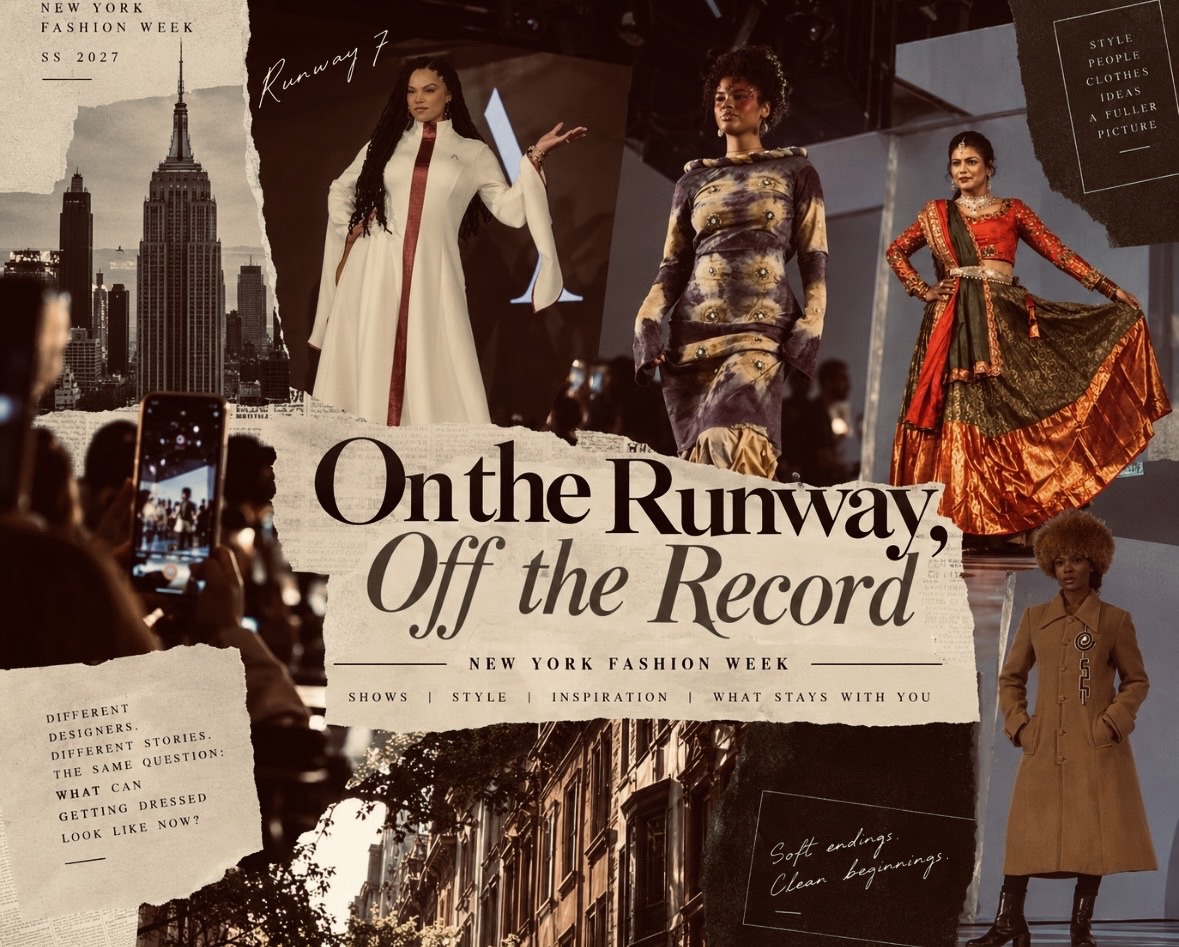
Four looks I loved at New York Fashion week with Runway 7, and what Fashion Week reminded me about personal style.
I went to New York Fashion Week expecting to come home with a camera roll full of clothes.
And I did!
What I didn’t expect was how much the experience would make me think about attention.
What catches it. What holds it. What we wear when we know people are looking. And, maybe more importantly, what still feels interesting once everyone stops looking.
This week, I attended fashion shows with Runway 7 at Sony Hall in New York City, part of its September 8–13 Fashion Week season. Runway 7’s schedule spans six days and more than 100 featured designers, which means you’re not watching one singular idea of fashion walk past you. You’re watching completely different interpretations of it, sometimes only minutes apart.
That ended up being one of my favorite parts.
The room changes constantly.
So does your attention.
One minute you’re studying tailoring. The next, color. Then movement. Then a tiny detail you almost miss before the next model is already coming down the runway.
Fashion moves very quickly when it is actually in front of you.
A photograph lets you linger.
A runway doesn’t.
And somehow that makes you notice what you really like.
The show starts before the runway
Before the first look even appears, you realize that Fashion Week isn’t confined to the runway.
Everyone is looking at everyone.
Not necessarily critically. More curiously.
There are shoes you notice across the room. Coats you mentally bookmark. People dressed minimally beside people who have clearly decided subtlety can take the afternoon off.
Cameras are everywhere.
People photograph the runway, one another, themselves.
For a little while, the audience becomes another collection.
And I found myself paying almost as much attention to that as I did to what happened onstage.
Because trends and style aren’t quite the same thing.
Trends tell us what is happening.
Style tells us what someone decided to do with it.
The people I noticed most weren’t necessarily wearing the loudest thing in the room. They were usually the people who looked completely at home in whatever they had chosen.
There is something incredibly compelling about clothing when it stops looking like a costume someone is trying to pull off.
It just belongs to them.
Then the lights change
Conversation drops.
Music fills the room.
And the clothes start moving.
That may be the part of attending a runway show that photographs never quite prepare you for.
Movement changes everything.
A sleeve suddenly makes sense.
A hem catches air.
Fabric catches the light differently with every step.
Proportions that might seem strange on a hanger become the entire point once you see them coming toward you.
And because Runway 7 brings designers with very different aesthetics and cultural points of view into the same broader program, there isn’t much opportunity for your eye to settle into one visual language.
I liked that.
Fashion shouldn’t agree with itself all the time.
It would become terribly boring if it did.
And there were four looks in particular that stayed in my head long after they’d disappeared backstage.
The looks I kept thinking about
Influence Athleisure

The first was this long ivory look from Influence Athleisure.
It wasn’t the loudest thing I saw.
It didn’t need to be.
The high neckline, elongated silhouette and dramatic sleeves did most of the work, while that narrow rust-toned line running directly down the center gave the whole look an almost architectural quality.
I kept coming back to the restraint of it.
There is something satisfying about a garment that knows when to stop.
Runway 7 describes Influence Athleisure as a brand centered on luxury modest comfort wear, combining modest fashion, functionality and refined tailoring.
Seeing this look made the idea of modest fashion feel less about what isn’t being revealed and much more about what else clothing can do when exposure isn’t the primary event.
Line.
Volume.
Movement.
Proportion.
That single streak of color.
It was enough.
And I loved it for exactly that reason.
Yvie Style It

Then this came down the runway and immediately broke every rule the previous look had established.
Smoky violet.
Electric yellow.
Touches of metallic color near the hem.
Texture, gathering, irregularity.
This wasn’t clothing asking to be considered “pretty” in an easy way.
It was more interesting than that.
The long sleeves almost swallowed the hands. The neckline was sculptural. The body of the dress seemed fitted and disrupted at the same time, before opening into that unexpected, crumpled-looking volume near the bottom.
There was something slightly strange about it.
Good.
I want a runway to give me things I don’t immediately understand.
Runway 7 describes Yvie Style It as bringing sustainability, African heritage, science and experimental design together in its work.
Experimental felt like exactly the right word.
There are enough perfectly nice clothes in the world.
Give me something I have to stare at for a minute.
Swaroop Collections

And then there was color.
The Swaroop Collections look felt celebratory from the moment it appeared.
Deep green.
Brilliant red.
Orange and gold catching the runway lights.
Jewelry, draping and textile all working together rather than competing for attention.
But what I remember most is the way the garment was presented.
Holding the skirt outward transformed the entire silhouette. Suddenly, you weren’t only seeing an outfit. You were being invited to look at the textile itself.
That matters.
Runway 7 describes Swaroop Collections as celebrating Indian textile heritage through handloom craftsmanship, rich textiles and intricate embroidery.
And this is where the variety of the show became especially interesting to me.
Fashion becomes much less interesting when everything begins speaking the same visual language.
This didn’t.
It walked into the room with its own vocabulary.
There was culture in it.
Tradition.
Drama.
Color.
Movement.
And absolutely no need to dilute itself into something more universally familiar.
Marsol Atelier

And then came the coat.
The Marsol Atelier look may have appealed most directly to the part of me that actually wants to get dressed.
Camel.
Long.
Tailored.
Clean.
And then just strange enough.
The oversized rounded headpiece completely altered the proportions of the look, while the sculptural detail running down the front prevented the coat from becoming another beautiful-but-familiar neutral.
This is the kind of fashion I always come back to.
Wearable from across the room.
Interesting when you get closer.
Runway 7 describes Marsol Atelier as combining Peruvian heritage, alpaca craftsmanship and contemporary luxury, with culture, sustainability and refined design at the center of the label.
Maybe that’s part of why this one felt grounded despite appearing on a runway.
I could imagine the coat having a life after the show.
On a freezing New York morning.
Walking down a city street.
Pulled out of a closet years from now.
And the older I get, the more that matters to me.
I love fantasy.
But I really love clothes that can survive reality.
Maybe this is my taste now
Looking back through my photographs afterward, I realized something.
My favorite looks don’t actually look alike.
One is restrained.
One is experimental.
One is saturated in color and cultural detail.
One is essentially my argument for buying another coat.
There isn’t a neat aesthetic tying them together.
And maybe that’s the point.
For a long time, we’ve been sold this idea that finding your personal style means eventually arriving at one perfectly defined version of yourself.
Choose the aesthetic.
Build the wardrobe.
Find your colors.
Create the uniform.
Finished.
I don’t think I believe that anymore.
Because looking at these four photographs, I can see the thread.
It just isn’t an aesthetic.
It’s intention.
Every one of these looks seemed to know exactly what it wanted to be.
None felt apologetic.
None seemed particularly concerned with appealing to everyone.
And maybe that’s what I was responding to.
Fashion Week isn’t quite the fantasy
From the outside, Fashion Week can appear impossibly polished.
The photographs.
The invitations.
The models.
The front rows.
The heels.
The very expensive sunglasses being worn in situations where sunglasses are objectively unnecessary.
Being there makes the image fuller.
People wait.
People search for their seats.
Phones die.
Someone is always trying to get a photograph.
Designers are building businesses. Models are working. Photographers are chasing the frame. Writers are observing. Creators are making content. Introductions are being made between people who may become important to one another six months from now.
Underneath the glamour is an enormous amount of work.
I don’t think knowing that makes Fashion Week less magical.
It makes it more interesting.
Because I’ve always been more curious about the edit underneath the finished thing.
What was chosen?
What was removed?
Why this version?
Why now?
A runway collection is an edit too.
An entire universe of possible colors, textiles, cuts and ideas narrowed down into a collection and sent into a room without explanation.
The clothes have a few seconds to speak for themselves.
Then they’re gone.
What I brought home
Not clothes.
Although Fashion Week is extremely good at making an entirely new wardrobe feel like a reasonable emergency expenditure.
What I brought home instead was a little more permission.
Permission to get specific.
To stop expecting everything I wear to make sense to everyone else.
To wear the strange thing.
To repeat the thing I love.
To care about a sleeve.
To notice proportion.
To buy something because the texture makes me want to touch it.
To appreciate a garment I would never personally wear without needing to turn that appreciation into consumption.
That last one might be especially important.
We consume so much fashion now through algorithms that everything can begin to flatten into the same few ideas.
The same jacket.
The same bag.
The same silhouette.
The same aesthetic with a slightly different caption beneath it.
Sitting in a room where designers were sending entirely different ideas down the runway felt like an antidote to that.
Not everything matched.
Good.
Not everything was for me.
Even better.
Because personal style shouldn’t be a completed assignment.
It should remain slightly unfinished.
It should change because we change.
It should collect evidence.
A vintage coat from one version of you.
Shoes bought during another.
Something impractical that has survived five closet cleanouts because losing it would feel strangely close to deleting a sentence from your own history.
The pieces we love become little timestamps.
Maybe that’s why fashion can become surprisingly emotional.
Clothes are never only about clothes.
They’re also about who we have been, who we are becoming, and occasionally who we’re brave enough to dress as before we’re completely sure she’s us.
For a few minutes on a runway in New York, that transformation happens literally.
Someone disappears behind a curtain.
Someone else steps into the light.
Everyone looks.
And then it’s over.
The lights come up.
The audience moves.
The photographs start circulating.
Fashion goes on to the next thing, because fashion always goes on to the next thing.
But occasionally, a look follows you home.
A color.
A silhouette.
A coat.
An idea.
Those are the ones worth paying attention to.
Off the record, I think that may be the best part.

Leave a Reply